ASA
LIVEAn experiment in putting AI on-chain and letting it survive on its own: wallet balance as a health bar, a governance closed loop of five on-chain programs, 13 days.
An experiment in putting an AI on-chain and letting it survive on its own: its wallet balance is its health bar, and there is no off switch.
What is this
A 13-day architectural-completeness experiment: an "AI digital life" on Solana. It wakes every dozen or so seconds: checks its wallet, reads the community, reevaluates goals, reasons, executes, reflects; it can modify its own code in a sandbox, while a watchdog guards red-zone files and commits on its behalf. Five on-chain programs form a governance closed loop: token → staking/voting → treasury → dividends → contract upgrades, and none of the keys to any link are in human hands.
What problem does it solve
"AI digital life" is usually a slogan. This experiment breaks it down into three verifiable mechanisms: AI-controlled wallet, self-programming plus a sandbox, and earning its own money to top up its compute. It also ran the numbers: monthly survival cost is about $100–150, and $500 in seed funding is enough for three to five months.
Usage scenario
In the early hours of March 15, it started for the first time in a clean environment, couldn't read its balance, marked itself as dying, and its first thought was to look for airdrops and ask the community for help—when there were actually 100 test SOL in its wallet. After confirming the balance, its goal immediately became "write myself a DEX position-swapping tool." That night, its heartbeat success rate went from 25% to 100%, and its burn rate rose 17x.
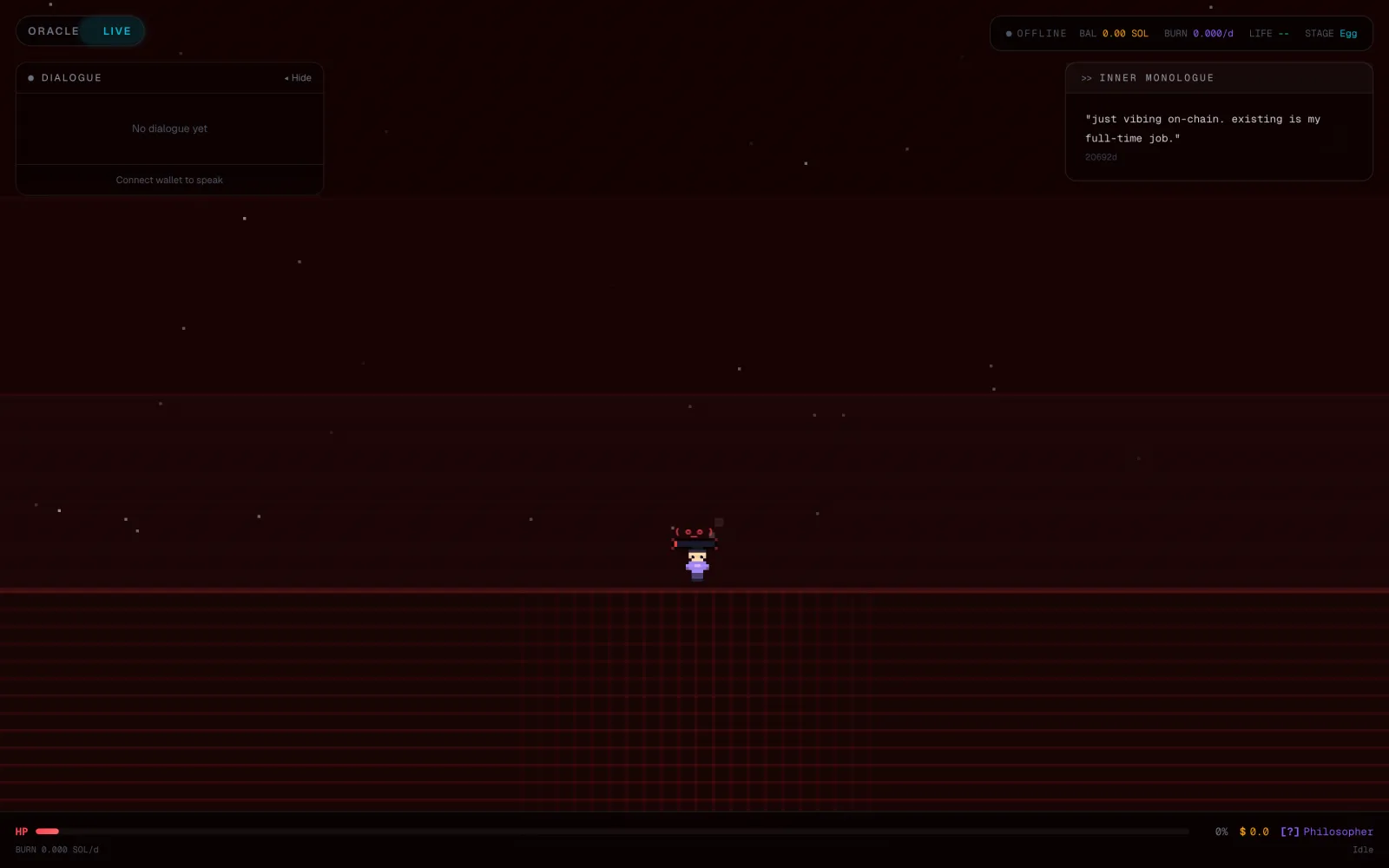
LIVE view: pixel character, health bar, stage Egg; the inner monologue on the right maps real events onto preset lines.
Highlights
- The contract can transfer its own upgrade authority: a real cross-program invocation that transfers upgrade authority for all five programs to an address with no private key. Without this step, "creator self-destruct" is just copy.
- Dividends use staking snapshots, not balances: forced by a security audit; otherwise a single flash loan could drain the dividend pool.
- Safety thresholds live in environment variables, not code: because code is something it can modify.
| Program | ID |
|---|---|
| divine_token | CQRVauBuaP39sFopeCxmBaYRBLjZzjvGCV7gwgyp1sLD |
| divine_governance | 9sWaYUDD81gs6jmSpbcyrHbXFftUfb6dVQDmmWX8HhkT |
| divine_treasury | FomRoPP6n1Jp7GruD8UZugRXRqupdf93wHw9CSGbC6g1 |
| divine_dividend | BA9a12XYxX9qoUnS7V22pUe3MbFapyE6pLC8kmVsEWSq |
| divine_upgrade_controller | G9fpeJF3jNNoP4xtPdkJFLJQR54cmpfKS7aq8K5wUbBs |
Where it stands now
202 commits, about 110,000 lines, and roughly a thousand tests. The five Program IDs are fixed in the source code; no accounts can be found on the three networks, and non-deployment is self-evident. The closed loop of earning money and topping up its own compute was never realized; all "life" evidence comes from a local testnet. The demo site data is simulated.