AI Helps You Write Code Faster—Who Actually Profits from the Time Saved?
A June report says 97% of teams are already using AI to write code, and 92% say they're faster. But only about three in ten actually pocket the time saved; the gap comes down to something that sounds boring.
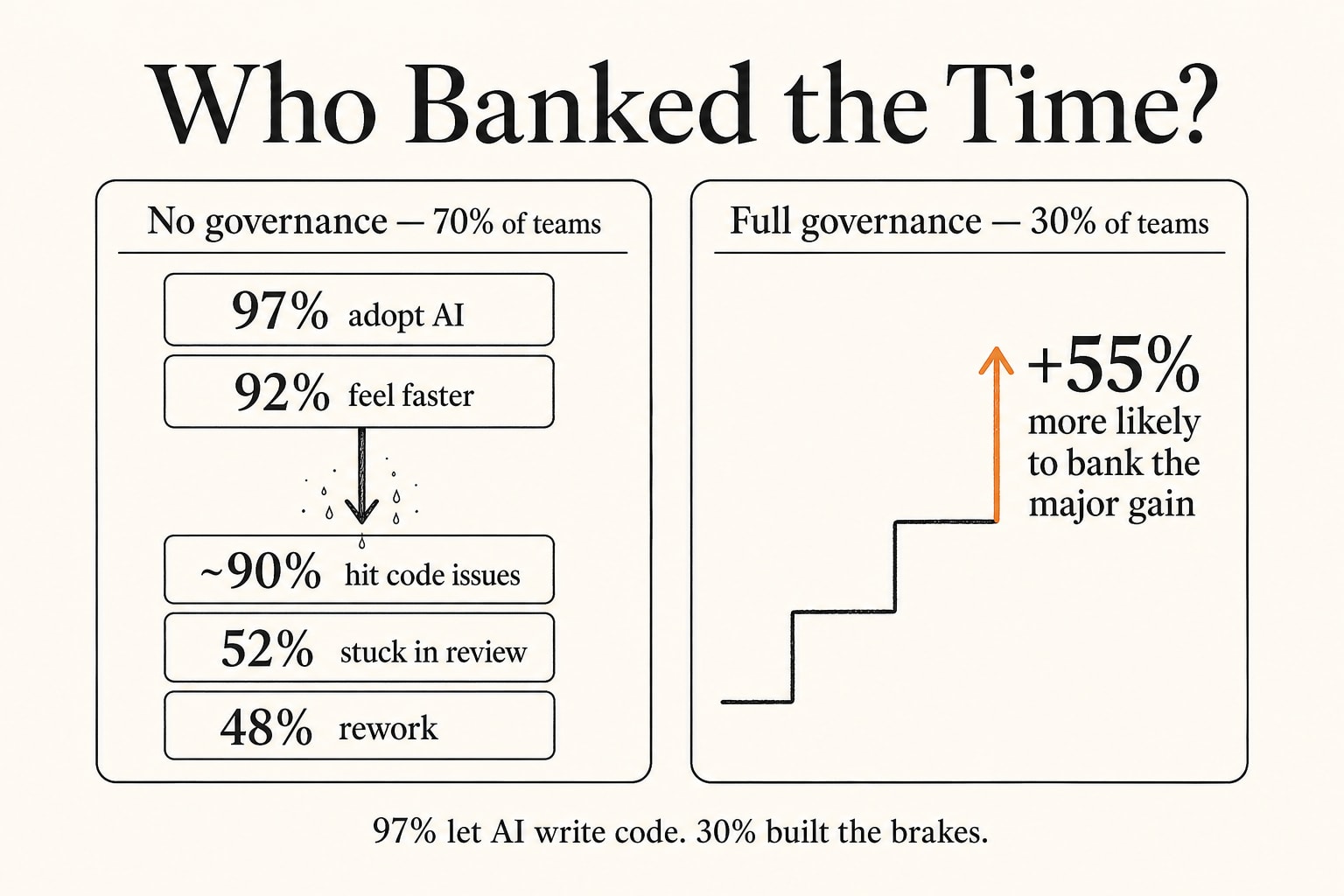
On June 9, a software security company called Black Duck released a report based on a survey of 831 engineers at large companies. The numbers read like an ad: 97% of development teams are already using AI to write code, 92% say they've gotten faster, and on average they save about eight hours a week. If the story ended there, the conclusion would be simple—AI makes building software cheaper and faster, and everyone wins.
But the same report also contains another set of numbers. Nearly 90% of teams have hit pitfalls with AI-generated code—code that runs but hides bugs or vulnerabilities. More than half got stuck at the review stage (where a person or tool checks line by line whether the code is correct and secure), and 48% got stuck in rework. In other words, AI paved the road faster for writing code, but teams didn't arrive any sooner. Much of those eight hours saved leaked back out the back door.
This leads to the report's most counterintuitive statement. Black Duck's CEO put it bluntly: treating speed as an advantage without putting governance behind it is actually accumulating debt. In plain terms, governance here means setting up a tracking and oversight system for AI-written code: who generated it, whether anyone reviewed it, and whether problems can be traced back to their source. That sounds like bureaucratic process that slows you down. But the data says the opposite. Only about three in ten teams have fully put such a system in place—and those very teams are 55% more likely to achieve "major efficiency gains."
Put in business terms: What AI really changes is where the bottleneck sits. Writing code has always been the fast part. The slow part has always been something else—confirming that it's correct.
You can think of AI as a new engine with three times the horsepower. A more powerful engine doesn't necessarily get the car there sooner. If the brakes, tires, and road conditions stay the same, you either lose control on a curve or spend all the saved time cleaning up accidents. The people who actually arrive earlier are the ones who also upgraded the brakes and the road. Governance is that set of brakes.
The software industry has a term for this: technical debt—the shortcut you take today for speed that you have to pay back with interest later, like running up a credit card. AI has pushed the cost of writing code close to zero, so people are swiping harder. One number from the report: more than half said their team's code volume grew by over 25%. The more code there is, the larger the surface area to review, fix, and be accountable for. The bill for cheaply generated code hasn't disappeared—it's just been postponed.
If you don't write code at all, what does this report have to do with you? A lot. Today, if you want to build a small app, a website, or an internal tool, the most tempting option is to have AI—or an outsourced team using AI—generate it in an afternoon, absurdly cheap. That path is often the right one; I take it often myself. I just want you to ask one more question before you commit: Where are the brakes? Has anyone reviewed this code, who is responsible when something goes wrong, and are your data and user information properly locked down? If something generated in an afternoon goes straight into production to handle real users and revenue, those eight hours you saved could come back tenfold as a data breach or an outage.
I work on AI agents every day—programs that can read data, call tools, and run code on their own. When starting a project, I build that layer of checks first, before thinking about features: which actions must pass a gate, whether every step leaves a trace, and whether errors can be rolled back. At first I thought this was just me being cautious. Reading this report made me realize that layer of checks is itself the 55% gap.
It's true that AI makes writing code faster, and the time saved is real. Whether you actually pocket that time depends on something far less sexy: whether you've also built the thing that can catch the errors. Speed is free. Keeping the speed is what takes real effort.