The “Because of AI” in Layoff Announcements Is Whitewashing an Old Decision for Bosses
In the 2026 wave of layoffs, more and more companies are citing AI as the reason. But a survey of 350 large companies found that the ones cutting the deepest didn’t see better returns. What exactly are those words hiding, and for whom?
Tech is laying people off at a startling pace in 2026. Add up a few public layoff trackers and, on an average workday this year, more than a thousand people are being let go—roughly double last year. What’s different from previous years is that more companies are willing to say the reason openly: AI. Behind names like Meta, Oracle, and Block comes the same line: “we’re restructuring for the AI era.”
It sounds like a story about technological progress. But there’s one number that tears a hole in that story.
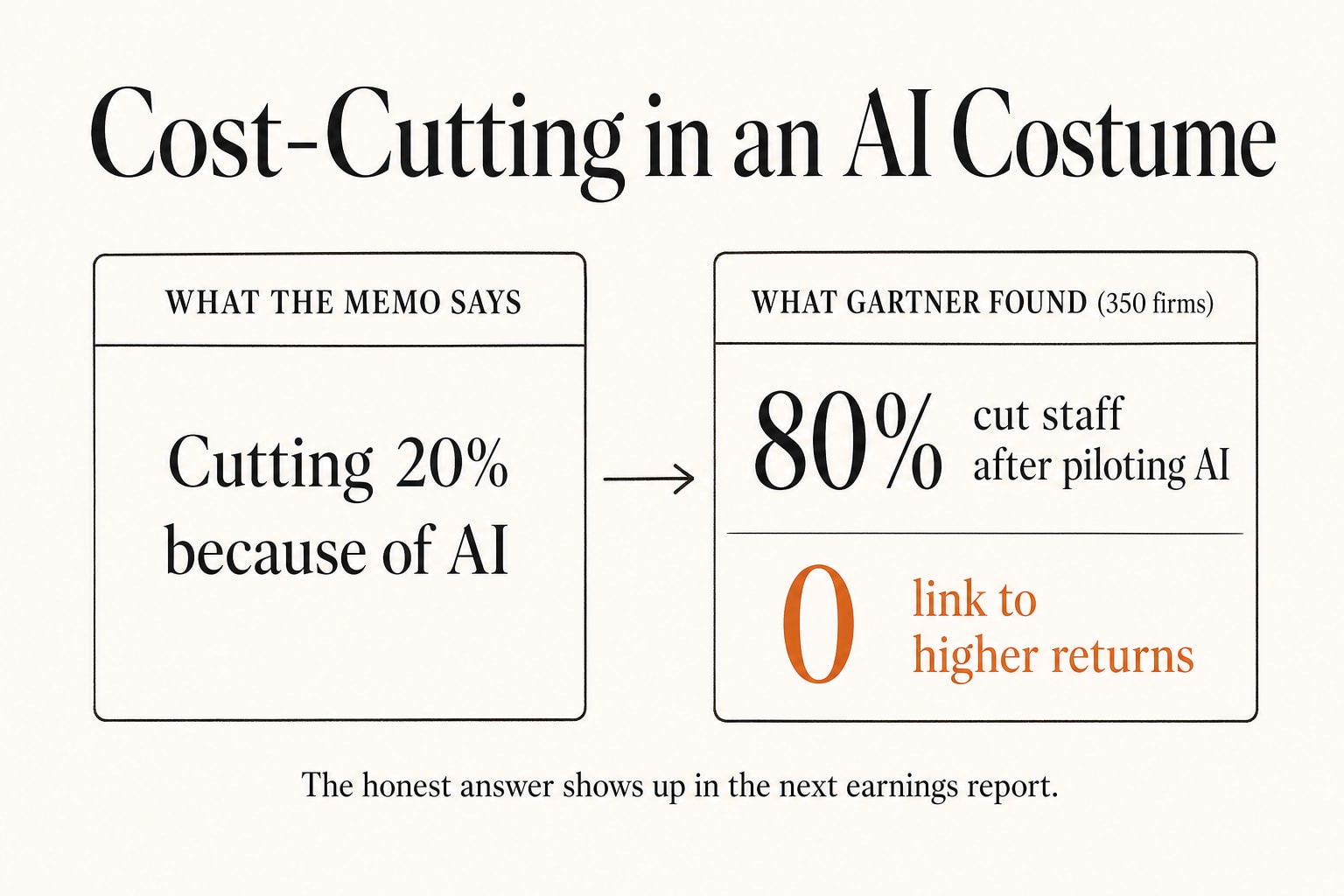
In May, the market research firm Gartner—which specializes in technology research for large enterprises—surveyed executives at 350 large companies with annual revenue above $1 billion. The result: among companies that had tried AI, 80% reported layoffs. You might hear that and think, “Sure enough, AI is replacing people.” But the next sentence in the same survey is the point. These layoffs had nothing to do with whether the companies made more money. The companies that cut the deepest did not see better financial returns.
In other words, many companies are cutting people while saying AI did it, even though AI hasn’t actually taken over those jobs. Gartner analyst Helen Poitevin put it bluntly: “Most companies that chase value only by cutting headcount will end up in a dead end of limited returns.”
Where does the value come from? The same research found that the real gains went to companies that used AI to amplify people: giving existing employees AI so that one person could do the work of two or three. The productivity increase came from making the people who stayed stronger. Replacing people with machines didn’t deliver the same effect.
I’ve spent years building AI agents—AI programs that can read data, call tools, and carry out tasks on their own—so I have a pretty concrete feel for this. Today’s AI can indeed absorb a large chunk of repetitive work, but what it can’t handle is judgment, accountability, and knowing who to call when something goes wrong. Give a skilled worker AI and their output can double. Cut that skilled worker and drop the AI into a role nobody has taken over, and what you get is less output plus a nice press release.
So those words—“because of AI”—are doing two jobs in many layoff announcements. One is real: some processes have indeed been automated. The other is PR: it puts a respectable, even forward-looking rationale on a decision they already wanted to make. A slowing economy, overhiring in the past two years, ugly quarterly numbers—those reasons are awkward to say out loud. “We’re embracing AI” might even lift the stock price. AI has become a washing machine that spins unflattering layoffs into a story about the future.
If you’re an investor, a boss, or someone evaluating whether a company is worth partnering with, here’s a practical test. The next time you see “we cut X percent because of AI,” don’t rush to marvel at how powerful AI is. First ask a dumber question: Where are the productivity numbers?
The logic is simple. If AI really took over the work people used to do, then the remaining employees should each be generating more revenue. Output per employee—company revenue divided by headcount—should go up. If a company only shows you lower costs but can’t produce evidence of higher output, then what it’s probably doing is ordinary cost-cutting dressed up in an AI coat.
It’s like a restaurant that cuts half its chefs and announces, “We bought a faster oven.” A faster oven is a good thing—it can help the chefs you kept work faster. But the oven still can’t cook on its own. A restaurant that actually uses AI well will turn out dishes faster and more consistently; one that’s just trying to save on labor will soon be exposed in how fast and how good the food is.
Gartner also has a prediction worth remembering: by 2027, half of the companies that expect to use AI to slash customer service teams will abandon the plan because the goal simply wasn’t met. That means many of today’s layoffs under the AI banner will quietly bring back some of those people in a year or two.
The most honest answer isn’t in the announcement—it’s in the next earnings report. If revenue stays the same or even grows while headcount shrinks, that’s real capability. If revenue shrinks along with headcount, then that “faster oven” is just a story. Look at how a company uses AI—whether it amplifies people or merely cuts them—and you can basically predict how far it will go over the next few years.