AI Video Reaches 30-Second Single Take: The Tech Passed, the Law Didn't
AI video has just crossed the 30-second continuous-shot threshold, yet the cease-and-desist letters from Hollywood's Big Six remain. Now that image quality is no longer the issue, the three questions you should really ask before choosing a tool are ones no demo video can answer.
Last week, ByteDance's AI video model Seedance 2.5 entered public release, bringing a capability no one else has yet matched: generating a continuous 30-second, seam-free video in one go.
This deserves an explanation of why it's a milestone. Previous AI video could only generate about 8 to 15 seconds at a time (Runway, Google's Veo, and OpenAI's Sora all sit in that range). To go longer, you had to stitch several short clips together end to end. The cost of stitching—cutting multiple short videos together into a longer piece—is obvious: seams that jump, a character's face subtly changing between segments, lighting flickering from one moment to the next. It looks machine-made. Seedance 2.5 claims to shoot the whole thing in one take, keeping faces, lighting, and camera movement stable from start to finish, and can even do 4K.
Thirty seconds doesn't sound like much, but it's exactly the length of a TV commercial. Under 15 seconds, you can't finish a story or hold a face long enough; once you cross 30 seconds, AI video finally reaches the threshold of "usable." In the past, when people said "AI video isn't there yet," they were relying on that telltale flaw you could spot at a glance. Now that flaw is gone.
But the same news has a second half, and that second half is the part for business people.
Seedance's previous version got into trouble precisely because it was too realistic. It launched in China in February, and within 24 hours, an AI-generated fake video of Tom Cruise and Brad Pitt fighting racked up millions of views. Within days, Disney, Warner, Paramount, Sony, Netflix, and Universal sent legal letters together. The Motion Picture Association (MPA), representing Hollywood's six major studios, issued its first cease-and-desist notice to a mainstream AI company, with strong wording: this kind of realism is precisely the selling point of the tool itself. ByteDance later voluntarily paused the global release, added watermarks and filters to block the generation of real people's faces and copyrighted characters. As of today, none of these legal disputes has been resolved.
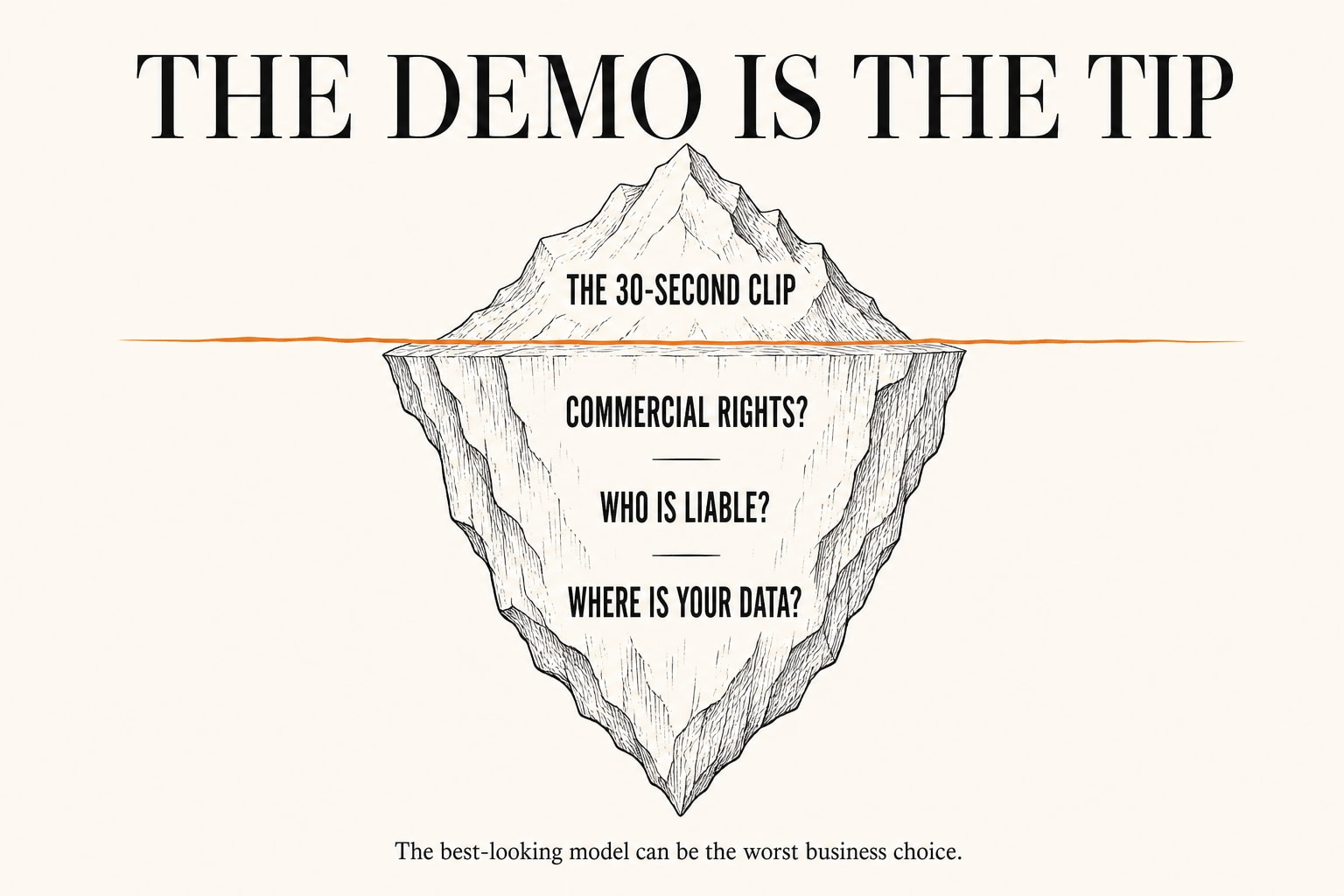
Put the two halves together, and you see what really matters for business people: now that the image-quality barrier has been crossed, the questions buyers should ask have changed. The more realistic the models become, the less meaningful the question "Does it look real?" becomes, because the answer is already "yes." The questions that really need asking—and that a demo video will never answer—are these three: Can I use this footage commercially, and who owns the copyright? If it happens to resemble a real person or an IP, who bears liability if something goes wrong? And where does the brand material, script, and client footage I feed in end up, and who controls it?
That last point is especially easy to overlook. Seedance is backed by ByteDance, a company within the jurisdiction of China's National Intelligence Law. In other words, the moment you click "Sign up," you are actually making two decisions at once: one about whether the image quality is good enough, and another about where your data goes and who can touch it. These two things are bundled into the same button, but they are two completely different matters.
I use AI to make things every day, and the more I use it, the more I feel something: the stronger a capability is, the bigger the trouble it can get you into. A model that can generate any person's face from a single sentence—its power and its problems are two sides of the same coin. So when I look at AI video tools, I stopped judging them by how beautiful their demos are long ago. A demo is the side the company tries hardest to show you, but it is precisely the least important side for making a decision.
Thirty seconds of continuous one-take video is a real capability, and I would use models like this too. But as soon as a video goes out under a brand's name, those three boring questions—can I use it, who bears responsibility, where does the data go—are the entire decision. The best-looking model might very well be the worst business choice.