What Broke Agents Wasn’t the Model—It Was an HTTP Endpoint Nobody Looks At
The LiteLLM vulnerability that CISA added to its Known Exploited Vulnerabilities catalog this week isn’t a model jailbreak—it’s an endpoint that executes the command field in your HTTP request. The whole agent world is staring at the top of the stack comparing models, while the breach is in the least-watched layer of plumbing.
This week there’s a piece of news going around security circles: on June 8, the U.S. CISA (Cybersecurity and Infrastructure Security Agency) added a vulnerability called CVE-2026-42271 to its Known Exploited Vulnerabilities catalog—meaning the hole is already being used in real attacks, not just on paper. What failed wasn’t a large model jailbreak, and it wasn’t an agent spinning out of control and deleting a database. What failed is something you’ve probably never heard of, yet it runs underneath almost every agent system: LiteLLM.
LiteLLM is a unified gateway—write one line of code and you can switch freely between GPT, Claude, and various open-source models without changing your business logic. Because it’s convenient, it became the default plumbing of the agent ecosystem: frameworks like CrewAI and DSPy often route model calls through it behind the scenes. One library, forwarding requests on behalf of dozens of frameworks.
Where is the vulnerability? In one of its MCP “preview” features (MCP is Model Context Protocol—the new standard that lets agents call external tools and services). Specifically, two HTTP endpoints, POST /mcp-rest/test/connection and POST /mcp-rest/test/tools/list, were meant to let you test a connection before saving an MCP server. The problem: they accept a complete server configuration, including the command, args, and env fields—and then actually run the command you send as a subprocess, with the privileges of the proxy process itself.
In other words, this is an endpoint that executes the command field in your HTTP request. This isn’t a memory corruption vulnerability that was cleverly bypassed; this is an endpoint that was designed to run whatever command you give it. GitHub’s official advisory (GHSA-v4p8-mg3p-g94g) puts it bluntly: these two endpoints “only validate a valid proxy API key, with no role check.” That means anyone with a key—even a low-privileged internal key—can execute arbitrary commands on the host. CVSS 8.7. Chained with another Starlette host header vulnerability, researchers upgraded it directly to unauthenticated remote code execution.
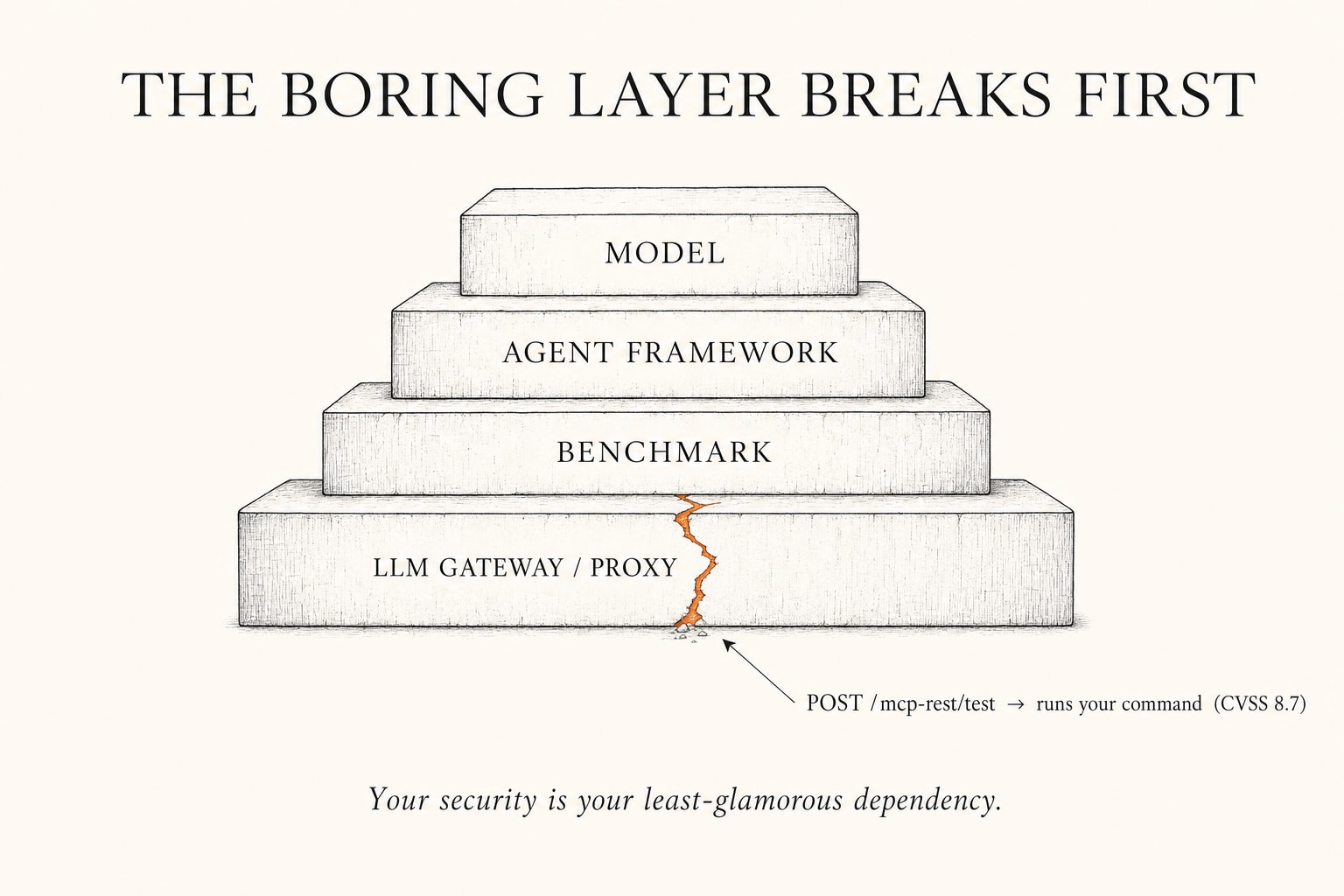
The judgment I want to make is this: the entire agent world’s attention is at the top of the stack, while the breach is at the bottom.
What do we compare every day? Which model scores highest, which agent framework is stronger, which benchmark just got a new record. Those are the topmost, shiniest layers of the stack. But what was breached this time was the bottom, least-watched layer—a “preview” feature on a request-forwarding proxy. No matter how smart the model or how elegant the framework, it won’t stop a hole in the plumbing below that executes commands.
And this hole grew precisely out of convenience. People use LiteLLM because it lets you switch models with one line of code—that’s real, worthwhile convenience. But the flip side of convenience is concentration: everyone depends on the same gateway, so one bug becomes everyone’s bug. One hole in one library instantly becomes a hole in dozens of frameworks and countless deployments. You think you’re using a lightweight tool, but you’ve actually bet the security of your entire stack on it.
There’s another layer worth calling out separately: the hole sits in a newly added capability. MCP only became hot last year, letting agents call external tools—that’s the direction where agents get stronger, and also where new attack surface grows. We add capabilities to agents far faster than we audit them. This endpoint is a “preview/test” feature, sounds harmless, but it accepts a command field and only checks “is there a key,” not “is this an admin.” Authentication is not authorization (authentication is “who you are,” authorization is “what you can do”)—treating those two as one thing is the root of this incident.
When I build agent systems myself, I have a habit: for any action that can spend money, run commands, or take actions externally, what stands behind the door must be a role check, not an API key. A key only proves you entered the door; it doesn’t prove you’re authorized to press that button. The fix this time did exactly that—version 1.83.7 changed these two endpoints so only the PROXY_ADMIN role can call them. One role check plugged a CVSS 8.7 hole.
So if you’re also building agents, here’s an unglamorous piece of advice: when choosing your stack, look at the least conspicuous dependency. Your security level isn’t determined by your smartest model; it’s determined by your most boring dependency. Models will get stronger on their own. The plumbing won’t secure itself—that’s your job.