You Installed 7 AI Tools and Work Got Slower
One report says the average designer’s AI tools went from 3 to 7 in a year, yet half are still looking for a main tool that feels right. The magic of these tools lives in those ten seconds of generation; what actually eats your time is the seams between tools.
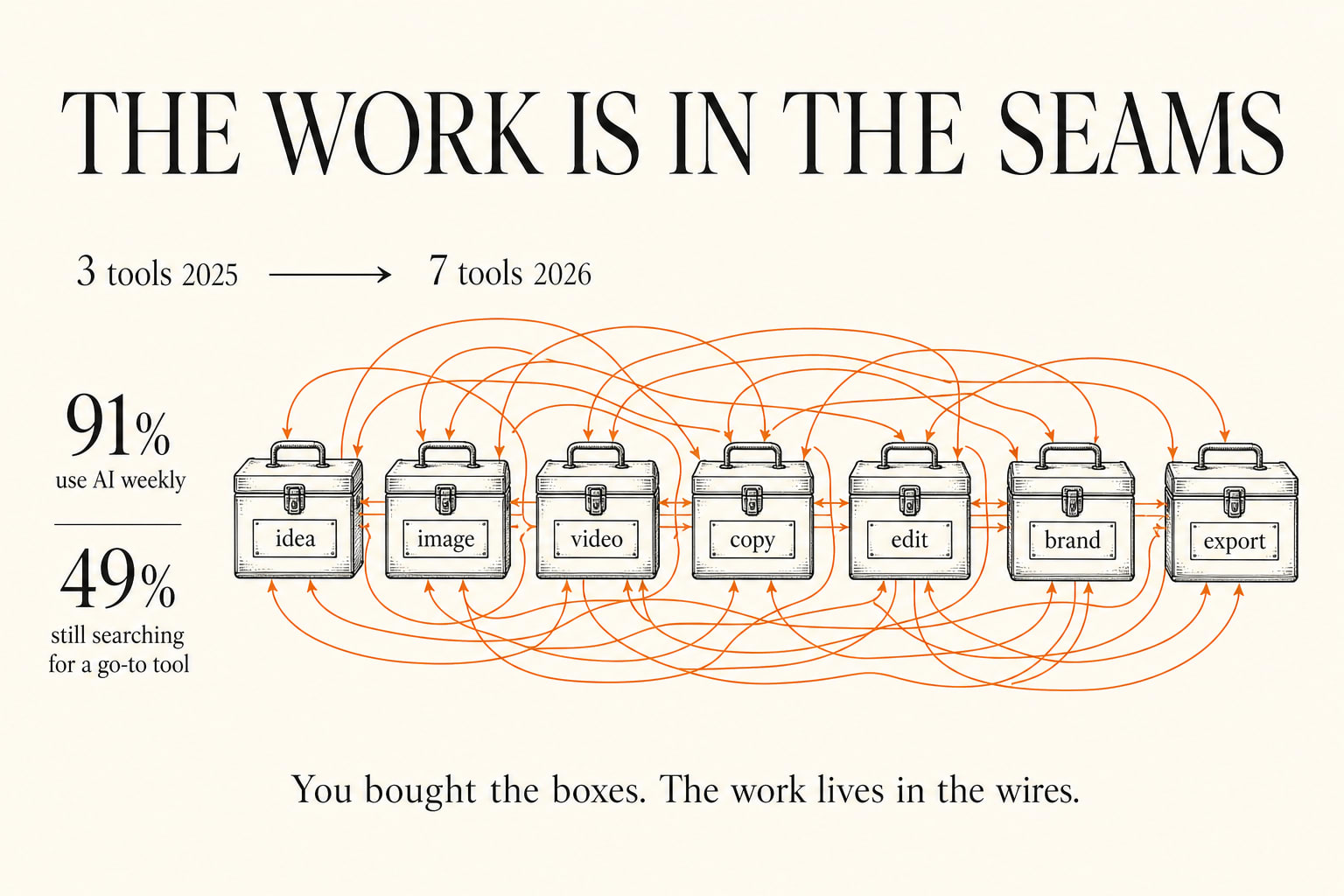
There is one number worth watching closely. The 2026 State of AI in Design report says the average designer’s AI tool count went from 3 to 7 in a single year. In the same report, 91% of people now use AI for work every week, up sharply from 54% last year. That sounds like a big win. Yet among those same people, nearly half (49%) say they are “still looking for that one main tool that feels right.”
Tools doubled, but certainty dropped. That’s worth thinking about.
Every AI tool launches with the same show: type a sentence, and ten seconds later it spits out a poster, a video, or a piece of copy. That show is beautiful, and it’s real. The problem is that those ten seconds are only the beginning of the real job. In an actual project, the other 90 percent of the time goes somewhere else: feeding tool A’s output into tool B, fixing formatting, checking brand tone, assembling scattered pieces into something deliverable, then going back to check whether it has confidently fabricated a statistic that doesn’t exist.
I call this part the seams: the connections between one tool and the next. The report’s “can’t find a main tool” confusion is rooted right here. Every time you add a tool, what you save is those ten seconds of generation; what you add is a brand-new set of seams between that tool and the six you already have. The generation work shrinks. The seam work grows. All told, seven tools are not necessarily faster than two. The extra five mostly give you more places for mistakes to slip through. A June article about enterprises put it bluntly: when a content team runs six AI tools at once with no verification step, output can multiply several times, and the risk of errors, brand drift, and made-up nonsense multiplies several times right along with it.
What’s more insidious is that obsession with “still looking for the main tool.” Many people blame their inefficiency on “not having found the right tool yet,” so they keep switching. But every time you switch tools, the seams you had built are all invalidated, and you have to piece them together from scratch. The act of searching is itself a trap: no single tool can cover everything end to end, so the search never ends. You think you’re upgrading; you’re actually resetting in place.
So what actually compounds? The seams themselves. It’s the pipeline you gradually build around two or three tools you stop swapping out: where assets enter, who checks brand alignment, which steps need human eyes, how finished work gets stored. This system doesn’t appear in any tool’s advertising. It grows in your own hands. I have the same experience building products: when you actually ship something, hands-on generation is at most ten percent. The other ninety percent is all connection work—making each handoff smooth so the whole thing can run over and over.
So if you’re a boss, a founder, or the person who pays for the team’s tools, here’s a practical test. Don’t be fooled by the demo (the product demo). When judging whether an AI tool is worth buying, watch less how beautifully it performs its ten-second magic, and more how cheaply it can slot into what you’re already doing. The shorter the seams, the more valuable it is.
To be concrete: freeze your tool stack (the set of tools you’re actively using at the same time). Pick two or three that cover the main stages, stop chasing new ones, and put the saved energy into the pipeline between them. A year from now, the peer who looks six times faster than you probably doesn’t have more tools than you do. They simply fixed the number of tools early and put all their effort into the seams. Tools will keep coming out, and each one will show you that same ten-second show. What will really make you fast is whether you’ve built the backstage after the show is over.