The all-you-can-eat era is over: your AI subscription is becoming an electricity bill
On June 1, GitHub Copilot moved to usage-based billing. One user had AI run four tasks automatically and burned through half a month's credits in a day. Most people see a price hike, but the more important change is that AI tool pricing has shifted from fixed subscriptions to variable utility bills—and that affects anyone who works with these tools and has to manage costs.
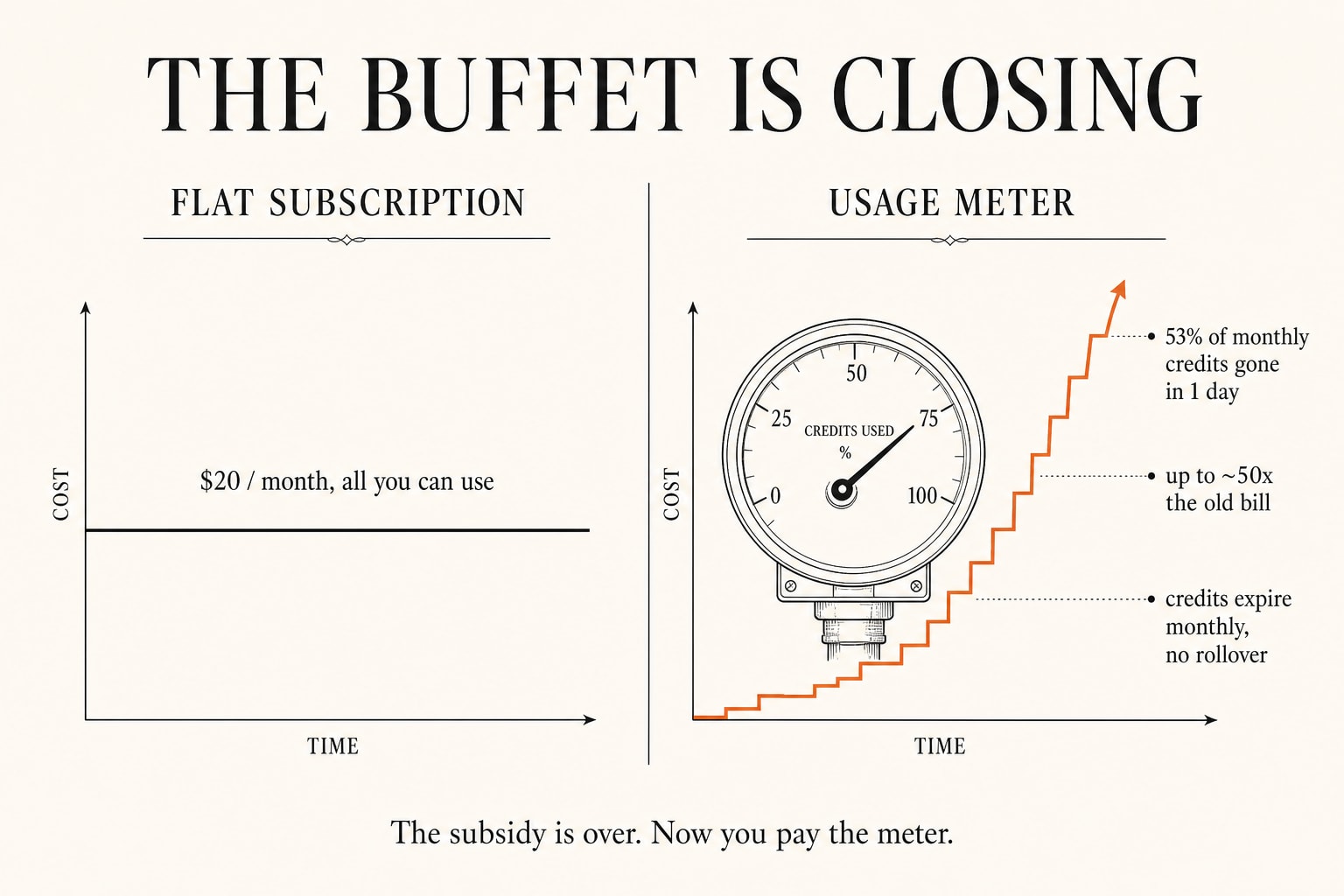
On June 1, GitHub Copilot—Microsoft's AI coding assistant and the most widely used in the world—changed its pricing. Previously it was a flat monthly fee: one price whether you used it a lot or a little. Now it has switched to usage-based billing (you pay for what you use, like running a water or electricity meter): each plan comes with a monthly credit allowance. The Pro plan costs $10 with $10 in "AI credits"; Pro+ costs $39 with $39; the Enterprise edition also costs $39 with $39. When the credits run out, you have to pay extra to keep going, and any credits you don't use in a month cannot be carried over to the next month—they expire and reset to zero.
As soon as the news came out, the official discussion forum was almost entirely negative. The most striking piece of feedback: one user let the AI run four tasks automatically and consumed 53% of the month's 7,000 credits in a single day; at that pace, it would be gone in two days. Another person calculated that for the same work, the new bill could be 50 times the old one.
Most people read this as three words: prices went up. The price increase is the surface. Beneath it, what deserves more attention is that the billing logic itself has changed: from "all-you-can-eat" to "running the meter". The real difference between these two models is who bears the risk. With all-you-can-eat, you pay a fixed amount, and if you use more, the platform loses. With metered billing, the more you use, the higher your bill, and the cost risk shifts entirely onto you.
Why did this have to happen? Because over the past year, how AI tools are used has fundamentally changed. Before, you asked a question and it answered, so consumption was small. Now the focus is on agents—AI systems that can run many steps on their own, read documents, modify code, and check their own work. You hand it one task, and behind the scenes it may burn dozens of times more compute. The irony is that platforms spent two years aggressively teaching you to "let the agent run on its own"—and that learned habit is now precisely the most expensive action.
This isn't just a Copilot thing. Last June, the popular AI editor Cursor did exactly the same thing: it quietly cut its fixed credits and switched to usage-based billing, touching off another wave of cancellations. The CEO publicly apologized, and a group of die-hard users defected to cheaper competitors. The fact that two leading products have made the same move within a year shows this is industry-wide. The early "$20 for unlimited use" era was essentially a subsidy period, burning investor money to grab market share. Subsidies always end, and the real cost eventually returns to the bill.
So for anyone who relies on AI tools to get things done and has to account for costs, here is a practical reminder: stop treating AI tools as a fixed subscription you buy and forget. Manage them like a utility bill. They are now a variable cost, in the same category as cloud servers and electricity, with the same risk of bill shock. When you hand out tools to a team, remember to set limits, watch usage, and regularly review who is burning credits and where. An unmanaged agent idling in the background overnight will become a bill you didn't expect at the end of the month.
There is also a new opportunity hidden here. When every call maps directly to money, doing the same job with less compute becomes, for the first time, a skill that saves real cash. Writing clear prompts, cutting tasks into smaller and more precise pieces, knowing when to let an agent run and when to solve it yourself in three lines—these used to sound like fussy perfectionism. Now they show up directly on the cost sheet. I run coding agents constantly myself, and the clearest change this month is that I now pause to ask: "Is this task worth letting it run fully automatically?" instead of reflexively pressing the button.
Magic has always had a price. Before, that money was charged to someone else's account, so you didn't feel it and assumed it was free. Now it is charged to yours. That isn't necessarily a bad thing: at least from this month on, you'll know exactly how much you're paying each day for each kind of convenience, and then decide which conveniences are worth buying and which ones you can just do yourself.