AI Tore Down the First Rung of the Career Ladder: If You Can't Be a Rookie, How Do You Become a Veteran?
AI has gobbled up the most junior grunt work in the workplace, and in doing so it has also torn down the stepping stones where newcomers used to learn the ropes. If you can't start as a rookie, how do you become a veteran? That is the question most worth taking seriously this year.
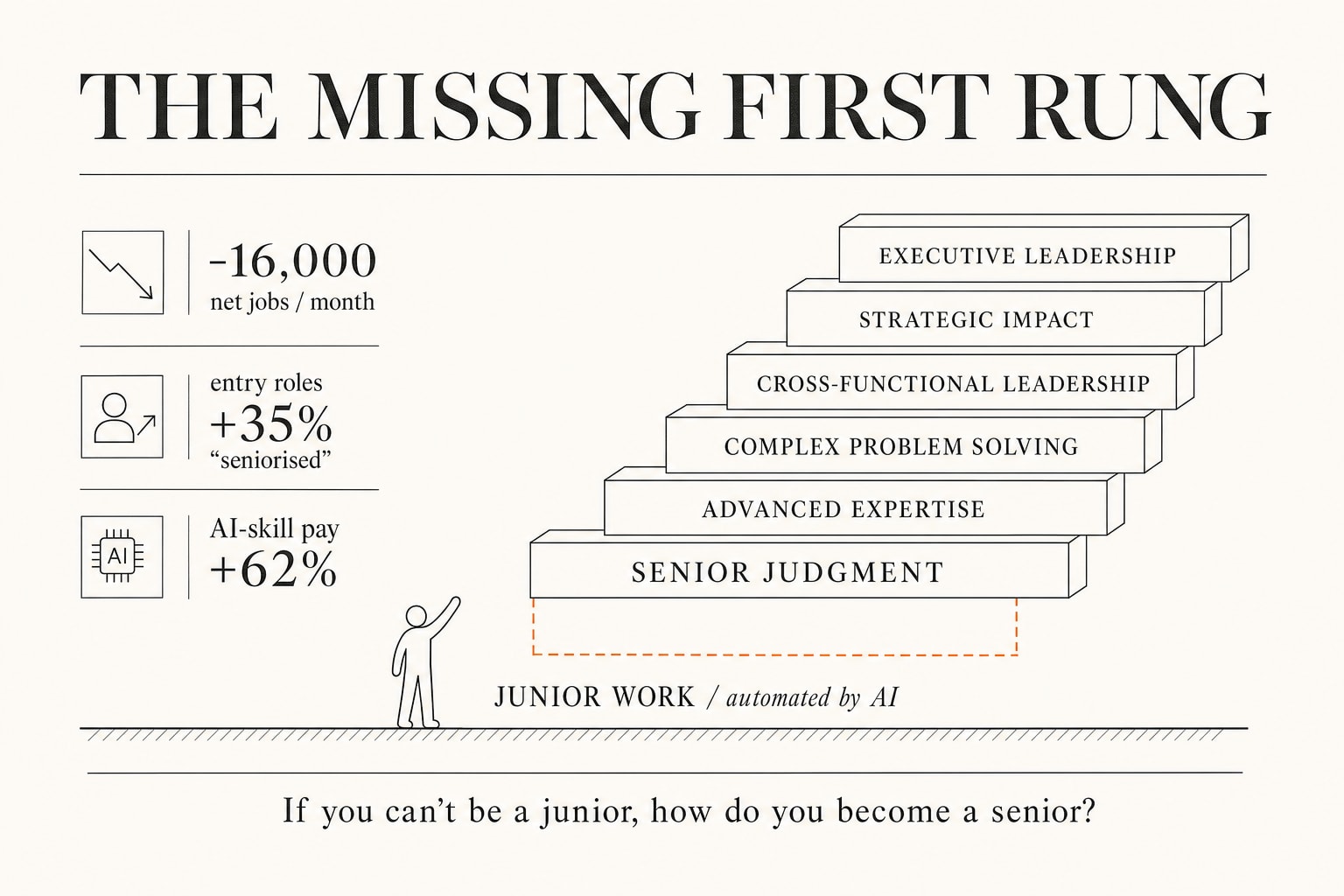
In April 2026, an economist at Goldman Sachs ran the numbers: over the past year, the U.S. saw a net loss of about 16,000 jobs per month on average, with 25,000 directly displaced by AI and 9,000 newly created by AI. The hardest-hit group was young people under thirty who were just entering the workforce. The reason isn't complicated: the work they did—data entry, customer service responses, organizing materials, running processes—is exactly what AI is best at right now.
The headlines are all shouting 'AI is taking jobs.' But if you focus only on the unemployment numbers, you miss something even more critical underneath: How does a person actually go from novice to veteran? The old answer was hidden in those unglamorous chores nobody wanted to do. In your first couple of years, you fetched coffee, fixed formatting, ran errands to verify data—it looked like cheap labor, but its real purpose was to let you slowly hone your instincts, judgment, and feel for the industry in a low-risk place. Those chores themselves were not valuable; they were the delivery vehicle for 'training newcomers.' AI has eaten those chores, and the 'training newcomers' bus has stopped running along with them. This mechanism ran for over a century, from factory apprentices to law firm juniors and hospital interns, all following the same logic: practice first in a corner where you can't cause major damage, and only after you're skilled do you move on to more important work.
PwC's Global AI Jobs Barometer this year (an annual report that tracks AI's impact on jobs by industry) lays this awkward situation bare. On one hand, roles that use AI skills are growing nearly eight times faster than overall employment, and people who have mastered this skill earn on average 60 percent more. On the other hand, entry-level jobs are becoming "seniorized": new hires are expected to arrive with judgment, the ability to lead others, and the resilience to handle pressure—this category of "premium entry-level roles" has grown by 35 percent since 2019, while ordinary entry-level roles have shrunk by 10 percent. Put bluntly: the market is dismantling the ladder for newcomers while demanding that newcomers start at the height of veterans. For example, a few years ago, a marketing newcomer spent the first year on layout, organizing backend data, and digging through competitor materials; today AI finishes those tasks in seconds, so the role either disappears or directly requires you to walk in already able to do strategy and understand the business. You can't be a rookie, yet you're expected to have a veteran's capabilities—that is the knot young people now face.
I have some personal experience with this knot. I'm an independent developer building products on my own, and from day one, AI has been doing all the 'newcomer chores': writing boilerplate code, researching materials, producing first drafts. By the old script, I had no ladder to climb at all. But instincts and judgment don't grow on their own just because there's no ladder. I later realized that honing judgment doesn't depend on the volume of chores you pile up. What actually matters is a different set of things: taking a small, complete piece of work from start to finish, paying for it yourself, shipping it yourself, bearing the consequences when things go wrong, and then absorbing the feedback the real world throws back at you. Losing money, getting yelled at by users, crawling out of bed in the middle of the night to fix a production incident—those are what truly teach you.
So I increasingly believe that what replaces the apprenticeship system is this approach of 'owning a complete, small piece of work with real responsibility.' For people just starting out, rather than competing for those vanishing junior roles, it's better to find early on a small thing you can fully take responsibility for and that has real stakes: take on a small paid gig, independently finish a small product that someone will actually use, make a decision within a real budget. Small scale is fine; what matters is that the consequences are real and the feedback is fast. Judgment is fed by real consequences, and it has little to do with job title or level.
For bosses, there's also something worth saying. AI has driven the cost of junior roles down to nearly zero, so cutting them looks like the smartest move in the short term. But the mid-level and senior people in companies today who can make judgments and handle pressure are all people who worked their way up from entry-level roles years ago. I've seen too many teams where, the moment AI arrives, the first cuts fall on interns and junior roles because that's the easiest money to save on paper. Replacing an entire layer of newcomers with AI is like eating next year's seed grain as this year's food. Three to five years from now, when those veterans retire, companies will suddenly find no one ready to step up, because no one was given a place to practice. The smart approach is to take part of the savings and deliberately create spaces for newcomers to practice judgment, even if it doesn't look cost-effective in the short term.
I don't think the old ladder can be rebuilt. It was a byproduct of cheap grunt work, and once that work disappeared, the ladder collapsed on its own. Unemployment numbers will fluctuate up and down, but what's truly worth worrying about is that an entire generation may lose the process of building judgment in a low-risk environment. Whoever can recreate that process—whether young people trying to move up or bosses who don't want to eat all their seed grain—will stand more firmly than others in the coming years.