Entry-Level Jobs Are Now Demanding Senior-Level Skills: AI Has Removed the “Learn From the Ground Up” Path
PwC scanned a billion job ads: roles labeled “entry-level” are 7 times more likely than other entry-level positions to demand senior-level skills. AI has pulled the apprenticeship that used to let you build real ability out of entry-level jobs—the shell remains, but the ladder upward has broken a rung.
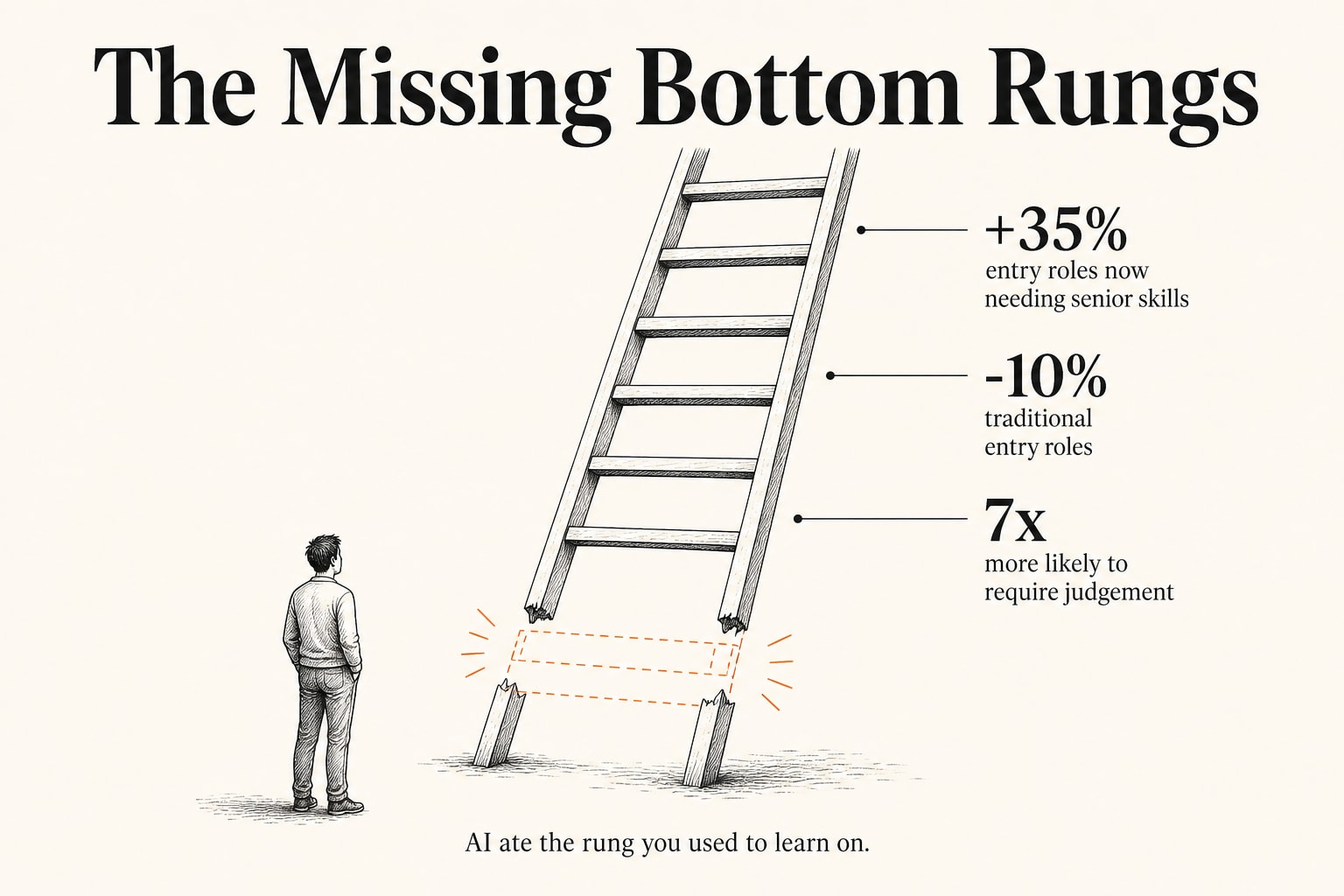
PwC (PricewaterhouseCoopers, one of the Big Four global accounting firms) released a report on June 15 that scanned 27 countries and more than a billion job ads. In it, there was one number I kept staring at: entry-level positions that AI has seeped into are 7 times more likely than other entry-level positions to require “senior-level skills”—things like judgment and leadership that used to be mentioned only for mid-level and senior roles.
In other words, many roles labeled “entry-level” or “open to new graduates” have quietly had their bar raised to a senior level. In the same report, these redefined entry-level positions have grown 35% since 2019, while traditional entry-level positions untouched by AI have actually declined by 10%.
Most people’s first reaction to AI’s impact on jobs is “AI is taking our jobs.” That framing is too crude. What’s actually happening is more precise and more troubling: AI is removing the part of entry-level work where you learned the craft. The job shell is still there, but the apprenticeship core is gone.
Let me explain. In the past, what did a new hire do after joining a company? Organize data, run the first round of research, apply formatting, write meeting notes, consolidate scattered material into a single page. At the time, these tasks looked like grunt work, but they had a second identity: they were the apprenticeship. While you did these unglamorous things, you were quietly learning how the industry operates, what good work looks like, and what your boss cares about. The pay was the salary; the side benefit was experience.
Now, these are exactly the tasks AI does most easily and cheaply. First-round research, first drafts, consolidation, formatting—a model can produce a version in seconds at near-zero cost. So companies naturally do the math: if AI can handle this grunt work, why should I pay for a slower new hire who also makes mistakes?
On paper, that math works. The problem is in what the paper does not show.
The grunt work being cut is also the only channel through which the company produces its future senior employees. Close that channel, and you save an entry-level salary today, but the senior employee you want five years from now has no place to grow. In the report, PwC’s global workforce leader, Pete Brown, put it with restraint: “AI is taking away the routine work that once served as an apprenticeship, while pulling the demand for judgment and leadership forward to an earlier stage in people’s careers.” Put in plain terms: you used to have five years to climb gradually; now companies expect you to show up on day one with five years’ worth of judgment.
This creates a distinct dilemma for two groups.
For business owners and managers, this is a hidden long-term risk. The productivity gains from AI are real: in the industries where AI has penetrated deepest, productivity (output per worker) has risen 34% over the past seven years, and the top 20% of companies have seen a 163% increase. Faced with numbers like these, cutting entry-level positions and letting senior people work with AI to cover the gap is almost inevitable in the short term. But you need to be clear about what you are trading for what: you are trading your talent inventory five years from now for this year’s profit margin. If the whole industry does this, in a few years the market will be missing an entire generation of mid-level professionals, and senior talent will become so expensive that you will regret the money you saved today. The report already puts the wage premium for AI skills at 62%, up from 57% last year, and it is still climbing.
For people just entering the workforce—or anyone with a new graduate in the family—the old path has to be reconsidered. “Start at the bottom, do the grunt work well, and slowly work your way up” has been repeated for decades, but part of its foundation has been pulled out. Grunt work is no longer your apprenticeship, because the grunt work has already been outsourced to AI. From day one, what you can offer in exchange for a position has to be the part AI still cannot do well: judging which result to trust, breaking down ambiguous problems, making a call when there is no standard answer, and getting a group of people moving in the same direction. These things used to be cultivated by putting in the years; now you have to find ways to train them ahead of schedule.
I work alone every day with a bunch of AI agents (AI programs that can read data, call tools, and run tasks on their own), and I feel this very directly. The models handle all my entry-level work, but the time they free up does not make things easier; it forces me to spend all of it on judgment: Is this project worth doing? Can this result be trusted? Should I let this step run on its own? This is exactly how one person can now replace what used to be a small team. AI has driven the price of grunt work through the floor; the only thing left with real value is your ability to set direction and take responsibility for the outcome.
So I do not read this report as bad news. It simply makes one thing clear: the era of “a position will wait for you to slowly mature” is over. Skills can still be built bit by bit, but the part the market is willing to pay for now points—earlier and more directly than ever—to judgment itself.